
You run Optimize. You look at the schedule, something's off, so you run it again — and get a different answer. You tighten up due-date performance and suddenly your lines are doing cleans they didn't do yesterday. Your schedulers have quietly stopped trusting the tool and spend half their day dragging jobs around by hand. Then one rush order from a key retailer lands and the whole plan detonates.
If any of that sounds familiar, here's the uncomfortable truth: PlanetTogether is doing exactly what you told it to do. The problem isn't the software. It's that, over the years, you've told it a dozen contradictory things — and now your optimization rules are working against each other.
In food and beverage this collision is especially expensive, because your "setups" aren't just tool swaps. They're allergen cleans, sanitation cycles, and product that's aging on the clock the whole time it waits.
It's tempting to think of Optimize as a button that finds the one best schedule. It isn't. Optimization is the art of making trade-offs, and every rule you turn on is you telling the engine which trade-offs matter more than the others.
Here's where most plants go wrong: they weight everything as important. Hit every ship date. Minimize every clean. Level-load every line. Keep every campaign together. Make to freshness and hold minimal finished goods. When you tell the optimizer that all of those are the top priority, you've actually told it nothing — because it's mathematically impossible to maximize all of them at once. So it does the next best thing: it defaults to whatever rule happens to dominate, and the schedule feels arbitrary and unstable.
And in most plants nobody sat down and designed the rule set. It accreted. A late shipment caused a fire drill, so someone bumped a weight. A surprise allergen clean ate a shift, so someone turned on sequence optimization. A filler kept starving, so someone added level-loading. Each change fixed one problem in isolation. No one ever went back to ask whether all these rules could coexist. Often, they can't.
This isn't abstract, so let's make it real with the two most common sequencing rules on a food line.
Almost every plant sequences its blending or batching area by allergen — run the allergen jobs together, then the non-allergen jobs, so you only pay for one big sanitation clean instead of several. And almost every plant sequences its packaging area by pack size — run all the 6-packs, then all the 12-packs, so you only change format once. Individually, both rules are completely sensible. Each one minimizes that area's own worst changeover.
The trouble is that they sort on different attributes. Here's what happens with two blenders and two packers, using the same eight jobs:
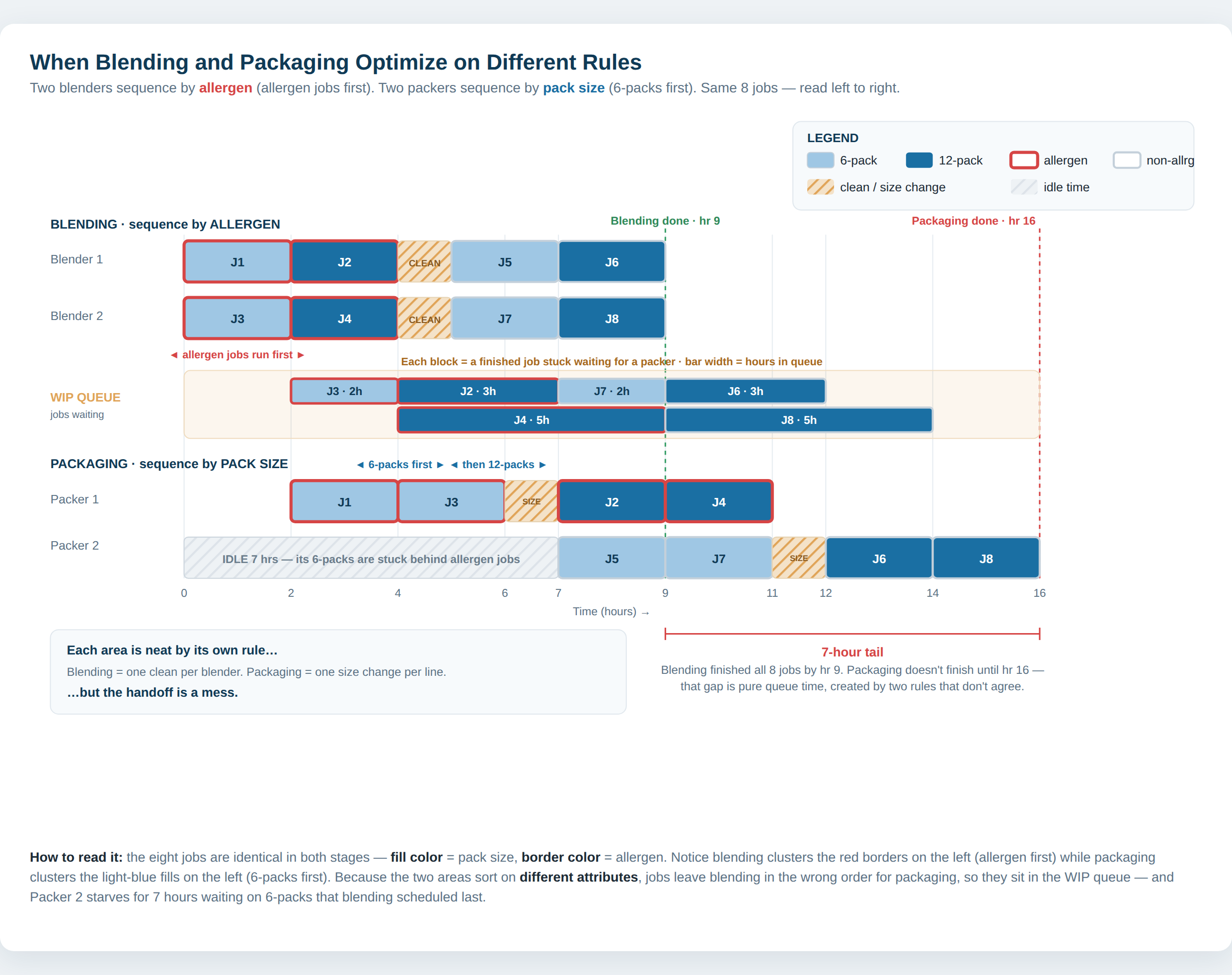
Every job keeps the same look in both stages — fill color is pack size, red border means allergen. Blending neatly clusters the red borders on the left; packaging neatly clusters the light fills on the left. But because the two areas sort on different things, jobs come out of blending in the wrong order for packaging. They sit in the WIP queue, and Packer 2 starves for 7 hours waiting on 6-packs that blending happened to run last.
Each area is locally tidy. The handoff between them is a mess. And nobody set a shared objective, so each area optimized itself and the plant as a whole lost.
One shift makes it undeniable. Here are 24 one-hour jobs — a full day's work — running through the same two blenders and two packers under the same two rules:
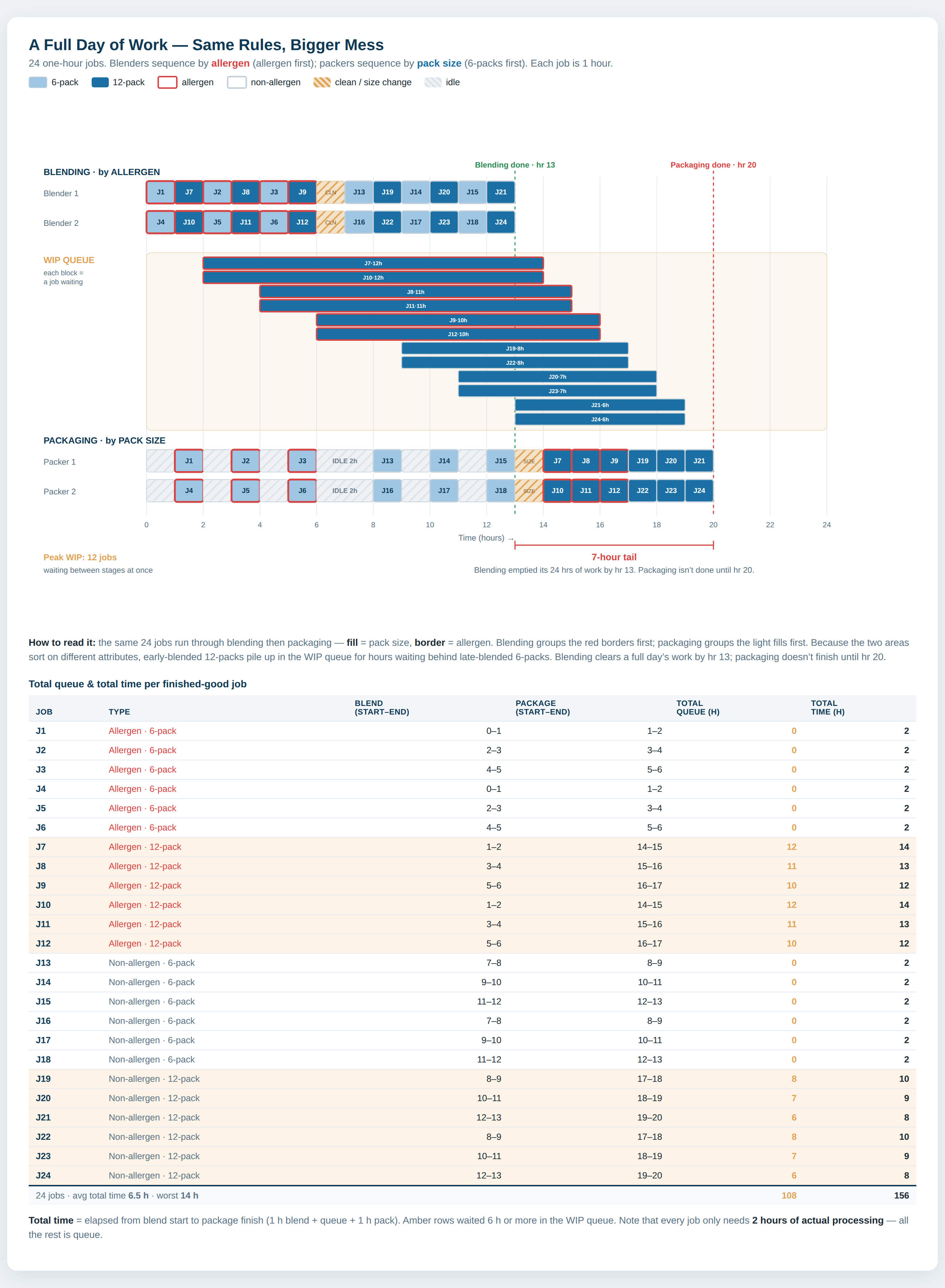
The blenders empty a full day of work by hour 13. But packaging, insisting on all its 6-packs first, can't touch the early-blended 12-packs — so they sit. Peak WIP hits 12 jobs waiting at once, and packaging doesn't finish until hour 20: a seven-hour tail of pure queue time.
The per-job numbers are the part that should sting. Every single job needs only two hours of actual processing — one hour to blend, one hour to pack. Yet under these two rules the average job spends 6.5 hours in the plant, and the worst spends 14. Across the shift that's 108 hours of queue against just 48 hours of real work. That queue is inventory sitting on the floor, burning code date, tying up cash, and hiding your true capacity.
Now watch what happens when the two areas stop disagreeing. Same 24 jobs, but packaging sequences by allergen too, so it can pull each job in roughly the order blending produces it:
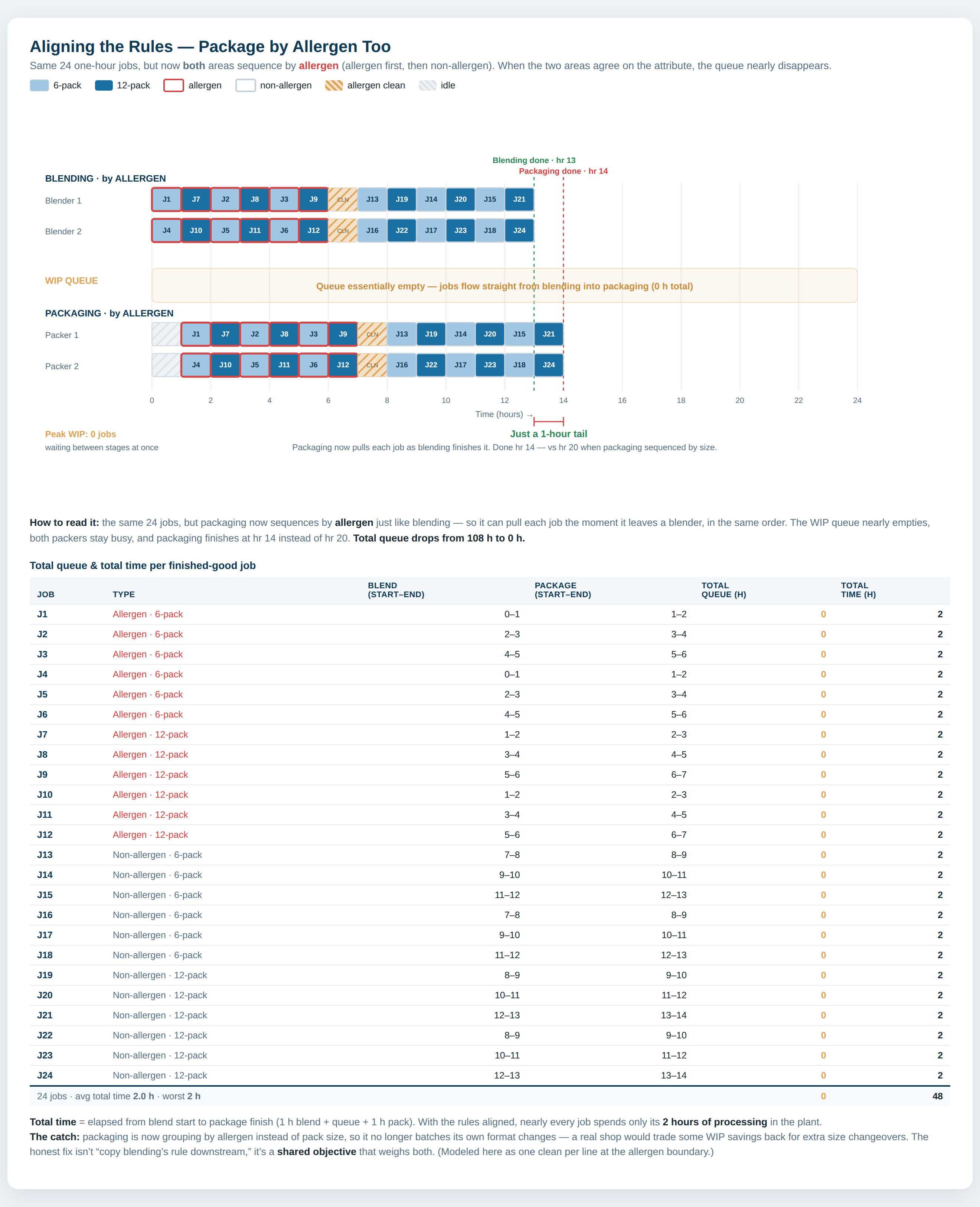
The WIP queue empties. Both packers stay busy. Packaging finishes at hour 14 instead of hour 20, and nearly every finished good spends just its two hours of real work in the plant. Total queue falls from 108 hours to zero. Seen part by part, every 12-pack gets six to twelve hours of its life back:
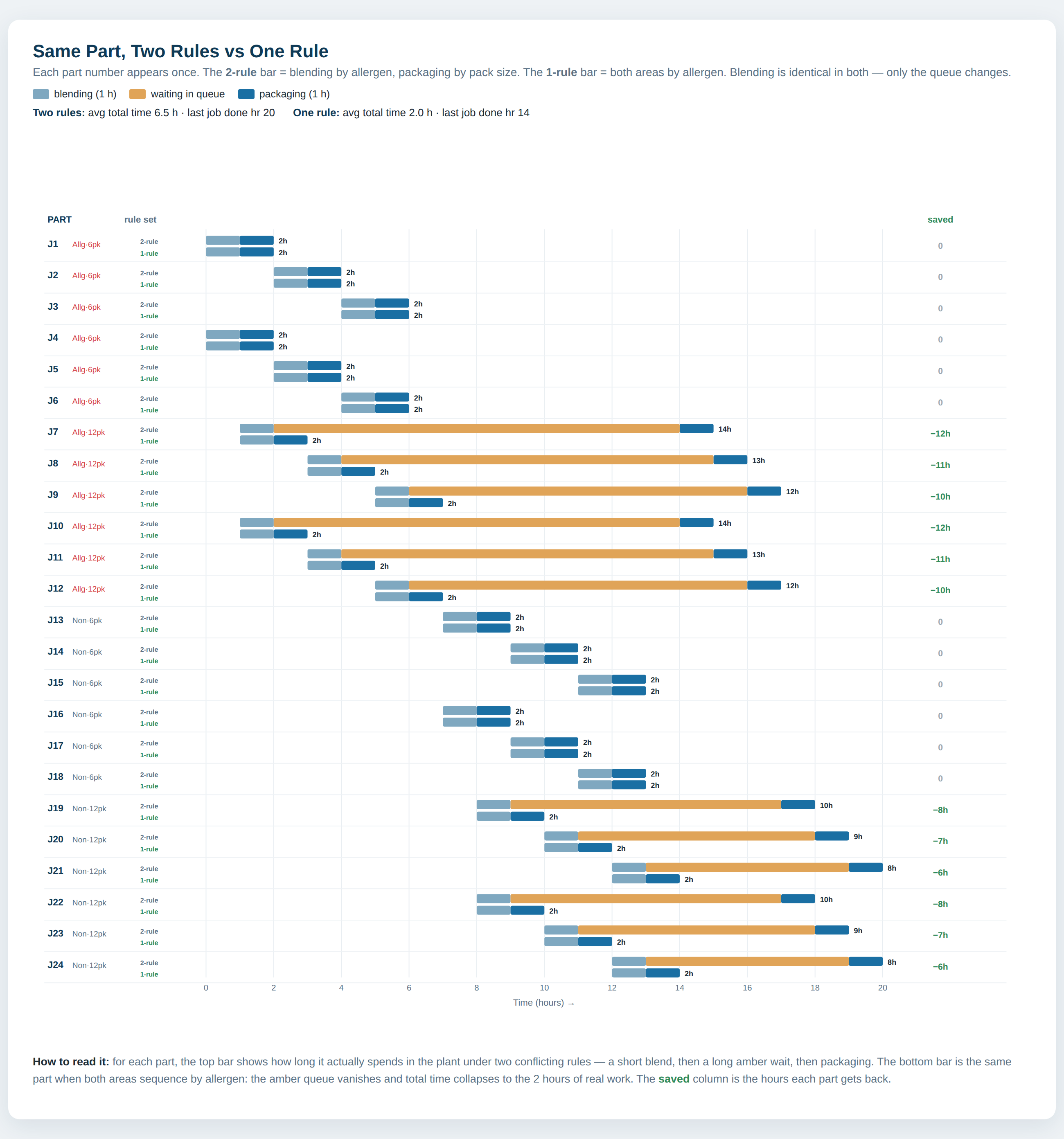
For each part, the top bar is life under two conflicting rules — a short blend, a long amber wait, then packaging. The bottom bar is the same part when both areas share a rule. The 6-packs never queued, so they gain nothing. Every 12-pack collapses back to two hours.
Here's the important nuance, because "just make packaging copy blending" is not the real lesson. Packaging's natural changeover is pack size, not allergen. Force it to group by allergen and you'll claw back that WIP win as extra format changes on the packaging line. There's no free lunch. The actual fix is a shared objective — one that weighs cleans, format changes, freshness, and queue against each other on purpose — rather than each area blindly optimizing its own local rule. In PlanetTogether terms, that means deciding what the plant is optimizing for, and making both areas' rules serve it.
The allergen-vs-pack-size clash is the most common one, but it's rarely the only one running in a food plant. Watch for these classic tug-of-wars, because turning any of them up quietly turns another one down:
You don't need to audit the config to smell the smoke. Score yourself:
Two or more of those, and your rules are almost certainly fighting each other.
The way out isn't a magic weight setting. It's a decision about what your plant is actually optimizing for.
Pick one primary objective and rank the rest beneath it, instead of weighting them all at the top. A schedule that knows "on-time first, then minimize cleans, then freshness, then utilization" beats one that's been told all four are equally sacred — every time, and predictably. From there, audit your current weights and your per-line sequencing rules side by side and hunt for the contradictions. Test your trade-offs deliberately: change one weight, and watch how the cleans-versus-lateness curve moves before you commit. Make sure your line-level rules serve the plant-level objective instead of quietly overriding it. And revisit your frozen span — is it protecting the schedule or handcuffing it?
Do that, and Optimize stops feeling like a slot machine and starts feeling like what it's supposed to be: a tool that makes your trade-offs on purpose.
Untangling a rule set that's been fighting itself for years is exactly the kind of work we do at Scheduling Solutions. If your PlanetTogether schedule feels like it's working against you, we can run an optimization audit — map your rules, surface the conflicts like the ones above, and get the whole plant pulling in one direction.