
Cleaning validation, campaign sequencing, QA release holds, and equipment qualified for one product and not the next — pharmaceutical manufacturing breaks the schedules that work everywhere else. PlanetTogether builds the finite-capacity plan that respects every one of those constraints. ScheduleIQ puts it on the floor and keeps it there as the shift changes.
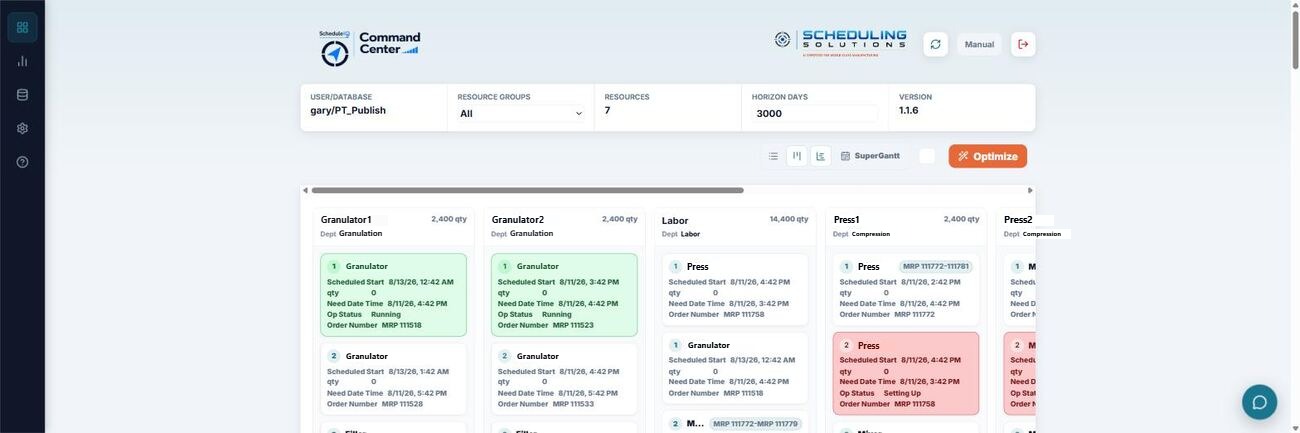
A live pharmaceutical line in ScheduleIQ — granulators, presses, and labor sequenced by resource, straight from PlanetTogether.
In most plants a job can wait. In a GMP plant a job waits for a reason — a validated clean, a release result, a qualified room — and every one of those reasons is a hard constraint, not a preference. Leave them out of the plan and the floor discovers them for you, one deviation at a time.
Setups are sequence-dependent and validated. Run a high-potency product ahead of a low-dose one and you have bought a full clean and a swab result instead of a minor changeover. The order you run in is the capacity you get.
Sampling, hold time, and release testing sit between the last operation and the shipment. A plan that stops when production stops is quoting a promise date it cannot keep.
APIs, intermediates, and finished goods all run on dated clocks. Material that will hit its retest date before it is consumed has to move first — or it becomes a write-off nobody planned for.
Rooms, vessels, and lines are qualified for specific products and specific processes. Two campaigns that need the same suite cannot both be right, and a spreadsheet will not tell you which one moves.
PlanetTogether’s Advanced Planning & Scheduling models what your plant actually does — the cleaning matrix, the qualified equipment, the QC lab, the release lead time — and schedules against those rules instead of around them.
Every sequence PlanetTogether builds is one you can defend: the cleans fall where the matrix says they must, campaigns are grouped for a documented reason, and the schedule is reproducible rather than remembered by one person.
The best plan in the world is worthless if the suite is working from a printout from Monday. ScheduleIQ is the live board supervisors actually run the shift from.
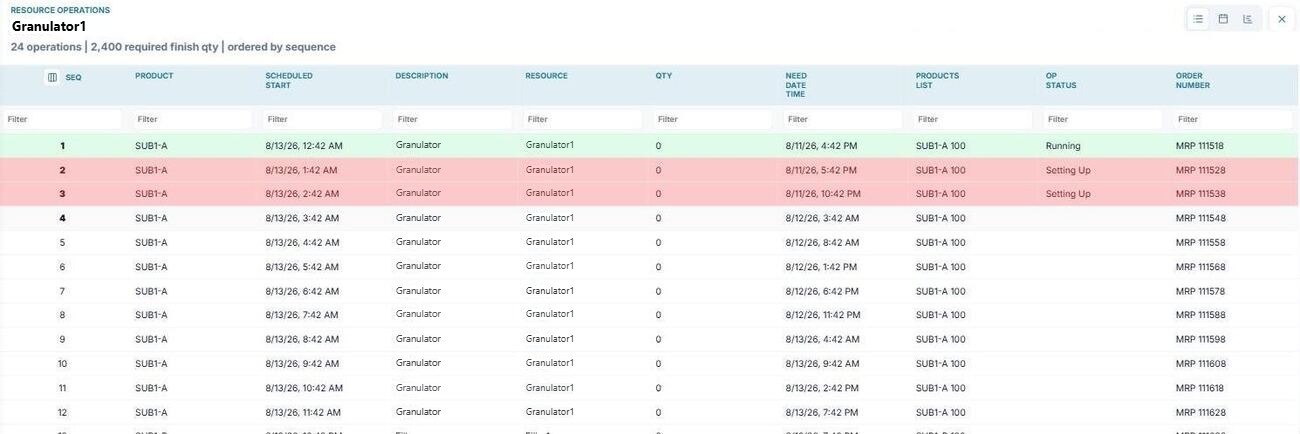
Open any resource and see its whole queue — sequence, scheduled start, need date and live status — in the order the plan intends.
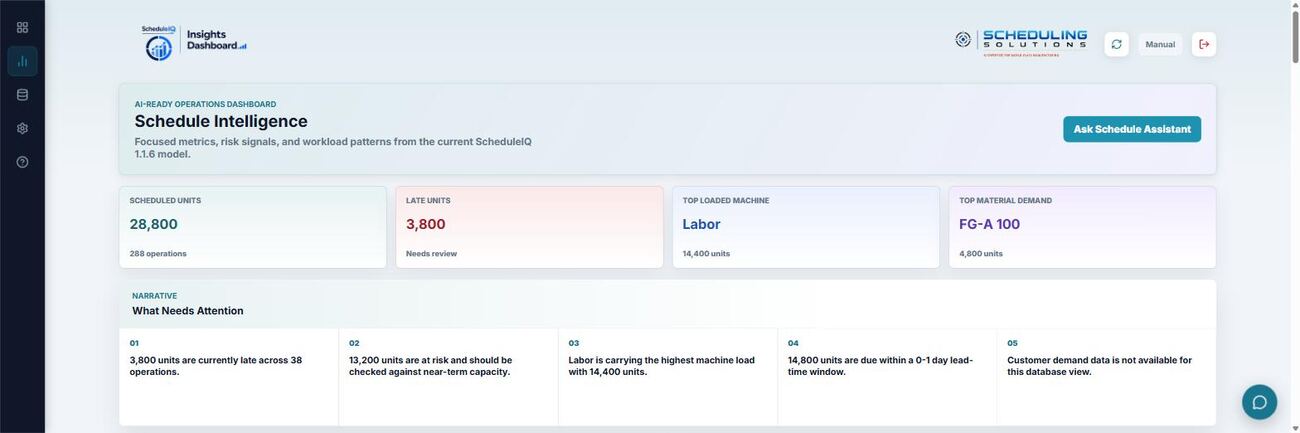
Late-risk batches, the most-loaded suite, and the jobs whose slack has quietly disappeared — surfaced while there is still time to do something about them.
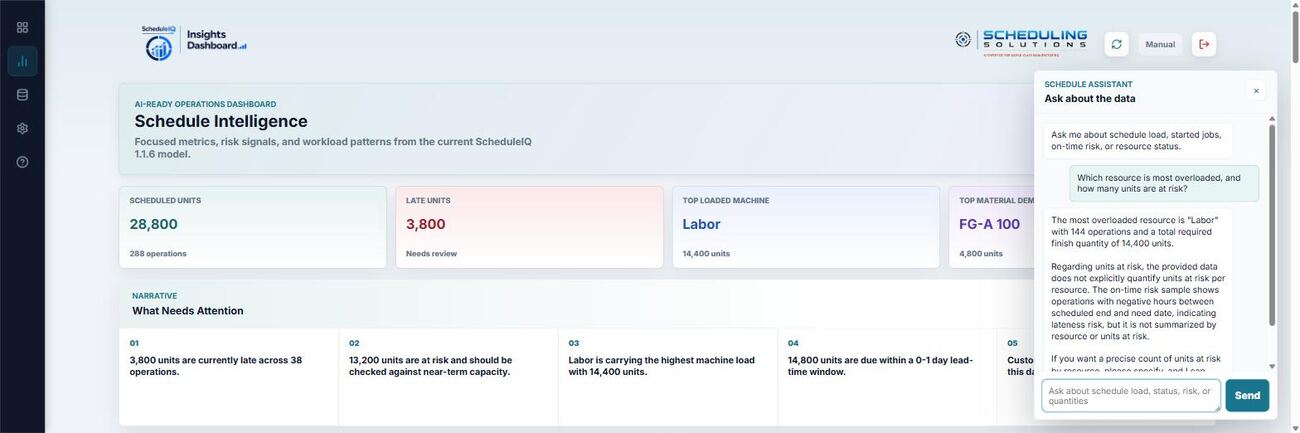
Your planners keep planning in PlanetTogether. Your supervisors get a board that always matches it.
APS builds the finite-capacity plan against your cleaning matrix, qualified equipment, QC capacity, and release lead times.
FINITE-CAPACITY APS
The day’s schedule flows straight into the dispatch board. No re-keying, no second version of the truth.
ZERO RE-KEYING
Supervisors dispatch, log status, and resequence around what actually happened, with AI flagging the batches at risk.
THE DISPATCH BOARD
How attributes and product rules drive sequence-dependent changeovers — the mechanism behind campaign grouping, cleaning classes, and the order you should be running in. Read the post →
Bring your cleaning matrix, your campaign rules, and your worst release week. We’ll show you the plan PlanetTogether builds and the board ScheduleIQ runs it on.