
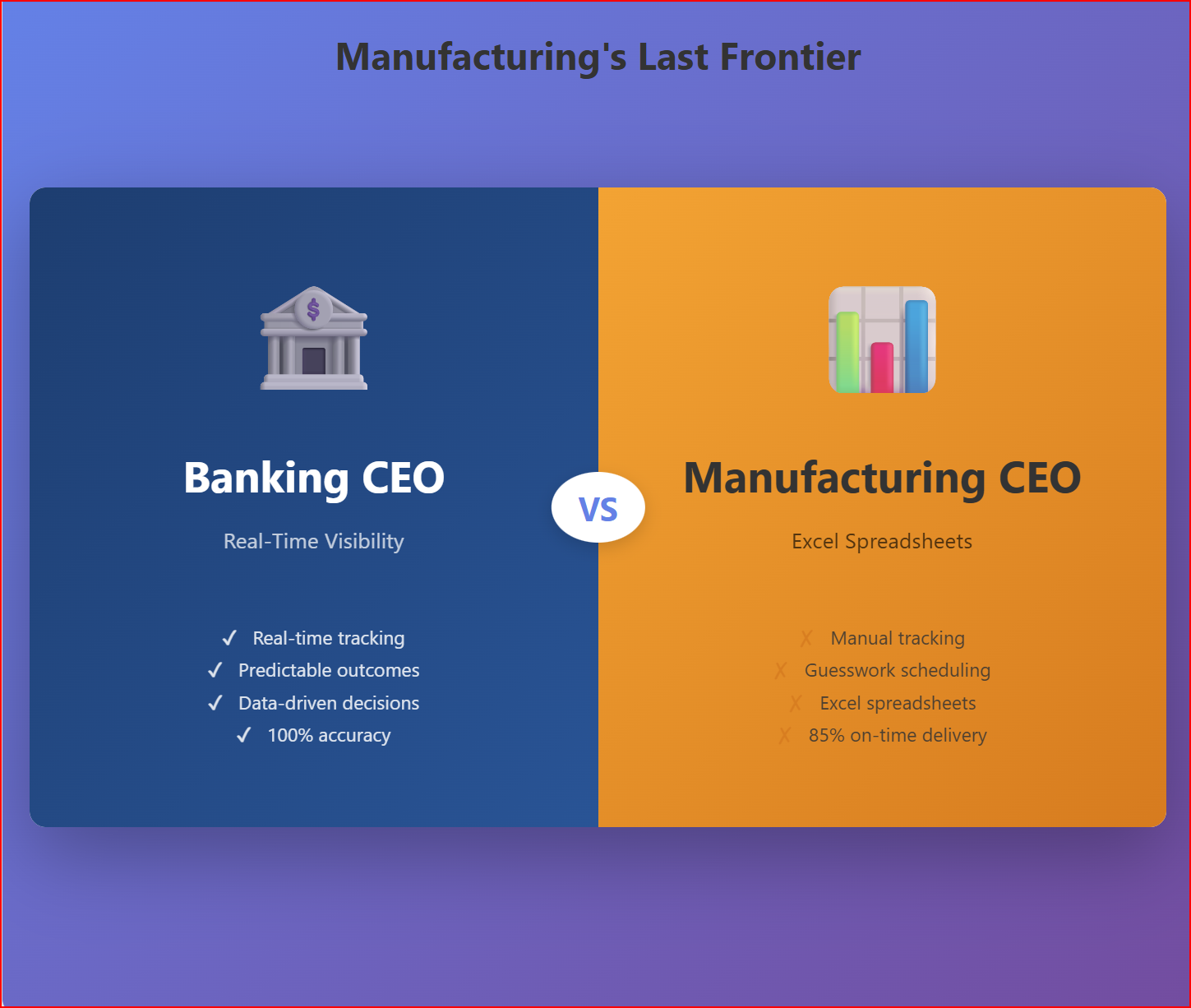
The conference room at a suburban hotel. A CEO from a regional bank sits across from the owner of a mid-sized manufacturer. They’ve just finished lunch. The banker leans back, curious.
**Banking CEO:** “So tell me—how do you actually schedule production? How do you tell a customer when their order will be ready?”
**Manufacturing CEO:** “We have a pretty solid process. The production manager keeps track of everything. We use Excel mostly. Works fine for us.”
**Banking CEO:** “Excel. Okay. So when a customer calls and says they need a run of 5,000 units by October 15th, how do you know if that’s possible?”
**Manufacturing CEO:** “Well, we look at what’s coming in, what’s on the schedule, how backed up we are…”
**Banking CEO:** “But do you know—actually know—how long it takes to make those units? Not a guess. The real time.”
**Manufacturing CEO:** “We have historical data. We know roughly…”
**Banking CEO:** “Roughly. Okay. Here’s what I don’t understand. I run a bank. Every transaction we process is tracked in real time. Every penny. Every second. Our customers can pull up an app and see exactly where their deposit is, when it cleared, what happened to it. We have zero ambiguity. How long does it take you to make a product?”
**Manufacturing CEO:** “It depends on a lot of factors. The machines, the materials, setup time…”
**Banking CEO:** “Setup time. How long is that?”
**Manufacturing CEO:** “Could be 30 minutes, could be two hours. Depends on what we were running before, what we’re running now. Our guys know, but—”
**Banking CEO:** “But you don’t track it systematically.”
**Manufacturing CEO:** “Not… formally, no.”
**Banking CEO:** “What about changeover? Downtime? Machine issues?”
**Manufacturing CEO:** “We catch those as they happen. The floor supervisor writes them down, or… sometimes they don’t write them down until later. We get the picture pretty quick.”
**Banking CEO:** “So if a machine goes down for four hours on Tuesday, and nobody writes it down until Thursday, you don’t have it in your schedule?”
**Manufacturing CEO:** “It gets corrected once we know about it.”
**Banking CEO:** “Once you know about it. So your schedule—the one you’re using to tell customers delivery dates—it’s not reflecting what actually happened on the floor? It’s reflecting what you think happened?”
**Manufacturing CEO:** “I wouldn’t say it’s inaccurate. The numbers balance out.”
**Banking CEO:** “The numbers balance out. Okay. So let me ask you this—and I’m genuinely asking. When you tell a customer that product will be ready October 15th, what percentage of the time does it actually ship October 15th?”
**Manufacturing CEO:** “Most of the time. Maybe… 85, 90 percent?”
**Banking CEO:** “So 10 to 15 percent of the time you miss the date. What happens then?”
**Manufacturing CEO:** “We talk to the customer. They usually understand. Most of them have been with us a long time.”
**Banking CEO:** “What does that miss cost you? Lost credibility? Do they order from a competitor? Do you eat the cost to get it out faster?”
**Manufacturing CEO:** “Sometimes. It’s… it’s the cost of doing business.”
**Banking CEO:** “I’m going to tell you something. In 2026, ‘cost of doing business’ is what you say when you don’t have visibility. When you know what’s actually happening—not what you think is happening—you can manage it. You can tell a customer, ‘October 15th,’ and October 15th happens. Not 85 percent of the time. All the time.”
**Manufacturing CEO:** “We’re not that organized.”
**Banking CEO:** “You’re not that organized? You’re a manufacturing company. Organization is what manufacturing is. But you’re managing it with—what was it?—Excel?”
**Manufacturing CEO:** “And people. Good people.”
**Banking CEO:** “Good people are expensive, and they’re also the problem. Your production manager knows a lot. But that knowledge lives in his head. The moment he leaves, or takes a vacation, or retires, what happens to your scheduling?”
**Manufacturing CEO:** “We’d have to rebuild it.”
**Banking CEO:** “You’d have to rebuild it. Meanwhile, how many customers can’t get accurate delivery dates? How many do you lose? How much inventory is sitting because you scheduled based on a guess instead of real data?”
**Banking CEO:** “Look, I’m not trying to attack you. But I’m genuinely confused. We’ve had the technology for this for—what, twenty years? Longer? And you’re still using spreadsheets and people’s memories.”
**Manufacturing CEO:** “We’ve looked at software. It’s expensive.”
**Banking CEO:** “How much is one missed delivery date worth to you? How much revenue? How much customer trust? Now multiply that by your miss rate—10, 15 percent—and tell me whether software is expensive.”
**Manufacturing CEO:** “The point is, it works for us.”
**Banking CEO:** “For now. But I’ll tell you what I see when I look at your operation. I see risk you don’t know you have. I see money leaving the table every time you miss a date or carry excess inventory because you don’t know what you’re actually capable of producing. I see your best people spending time managing schedules instead of solving real problems. And I see your competitors—the ones who do have visibility—slowly taking your customers.”
**Banking CEO:** “So I guess my last question is: how long can you stay competitive with 85 percent accuracy when the market is moving toward certainty?”
The manufacturing CEO looks out the window.
**What would you tell him?**