
The Most Expensive Ten Minutes on Your Food Line
Why the order you run products in quietly decides how much capacity you actually have — and how to stop giving hours away every shift.
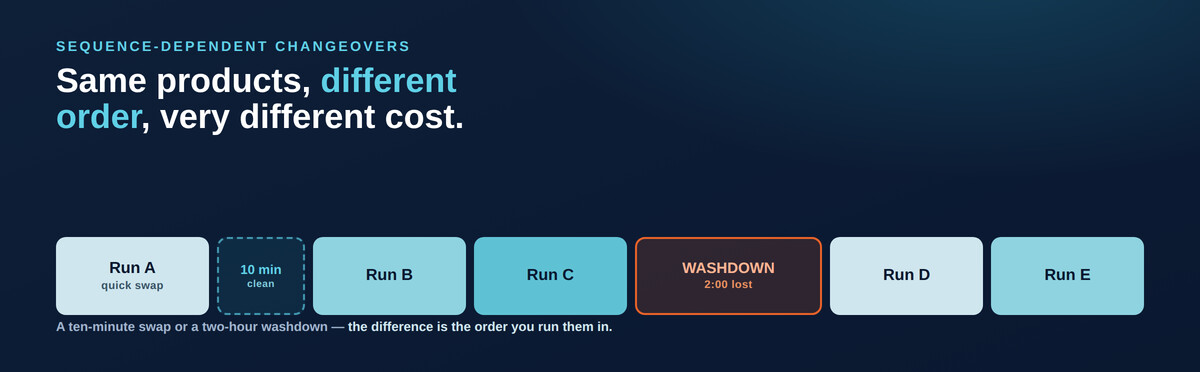
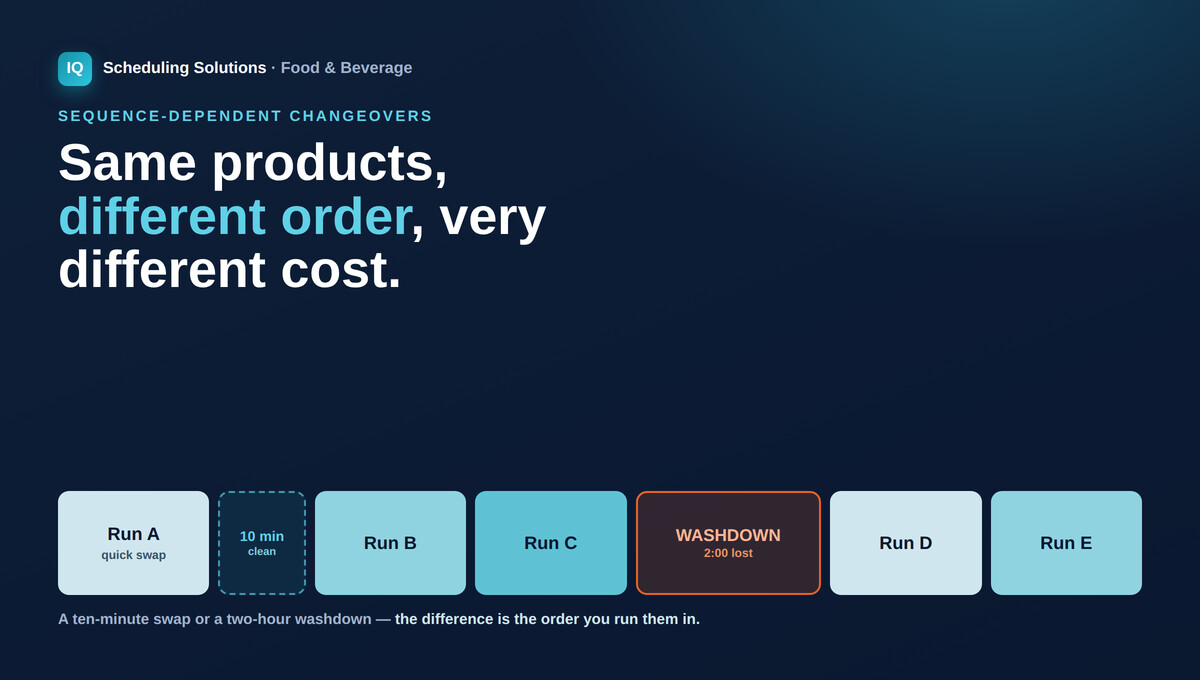
You run the same two products on the same line every week. One day they run back to back and the operator swaps over in ten minutes. Another day, same two products, and you lose two hours to a full washdown before the second one can start.
Nothing changed except the order you ran them in.
That’s the uncomfortable truth about changeovers in food and beverage: the cost isn’t the changeover itself. It’s the sequence. And most plants are paying for the wrong sequence over and over without ever seeing it on a report.
Sequence is money
On a food line, setups are sequence-dependent. Run a low-allergen product before a high-allergen one and you might get a quick clean. Flip the order — or drop a wet product in behind a dry one, or a dark flavor before a light one — and now you owe a full sanitation cycle, an allergen washdown, and a line that sits idle while it happens.
Multiply that by every changeover, every shift, every line. The hours don’t show up as a line item. They hide inside “that’s just how long changeovers take.” But a meaningful share of that time isn’t the changeover — it’s the penalty for running things in an order that forced a cleandown you didn’t need.
Why the spreadsheet can’t win this
The obvious answer is “just sequence it better.” The problem is that a good sequence isn’t something you can eyeball.
You’re not ordering two products. You’re ordering dozens, across multiple lines, against due dates, shelf-life windows, material that’s about to expire, and a finite number of hours in the week. Optimize for changeovers and you might blow a delivery date. Optimize for due dates and you might triple your washdowns. Every choice trades against the others, and the number of possible sequences is enormous.
A planner with a spreadsheet can find a schedule. Finding the one that protects capacity and your delivery dates and your shelf life, all at once, is a different kind of math.
What finite scheduling actually changes
This is the job a finite-capacity scheduler like PlanetTogether is built for. It knows your setup rules — which products share allergens, which transitions are cheap and which trigger a full clean — and it sequences the week to minimize the expensive ones. It groups compatible products into runs, orders them allergen-free to allergen-containing, and folds in due dates and material expiry at the same time.
The result isn’t a prettier Gantt chart. It’s line hours you were already paying for, handed back to you — without missing the orders those hours were supposed to protect.
Winning the hours back is only half the battle
Here’s where a lot of good plans quietly fall apart.
You build the optimized sequence. Then a line goes down, a tanker shows up late, or a customer calls with a hot order. Someone on the floor resequences the day to cope — and if they’re doing it blind, they undo exactly the savings the plan created. The changeover discipline that lived in the schedule doesn’t survive contact with reality.
That’s the gap ScheduleIQ is meant to close. It takes the live PlanetTogether schedule and puts it in front of your floor as a dispatch board — today’s runs by line, in the intended order — so when the day changes, supervisors can react without accidentally trading a ten-minute swap for a two-hour washdown. The plan built the good sequence. The board keeps the floor running it.
The quiet win
Nobody puts “ran products in the wrong order” on a scrap report. It’s the easiest cost to overlook precisely because it never announces itself. But for most food and beverage plants, it’s one of the largest pools of capacity hiding in plain sight — and unlike a new line or a new shift, claiming it doesn’t cost anything except a better sequence.
If you’ve never actually measured what your changeover order is costing you, that’s the place to start.
Curious how much capacity your current sequence is giving away? See how PlanetTogether and ScheduleIQ keep food and beverage lines on schedule — explore Food & Beverage scheduling, or reach out for a quick assessment of your changeover profile.